Recruiting emails get ignored when they reach the wrong coach, too late, with the numbers buried. Softball Bound keeps current coach contacts for every NCAA, NAIA, and JUCO softball program, drafts each email from your player profile, and shows you which schools have gone quiet.

No download needed: sign up and use the web app →
Program search, coach contacts, school academics, and recruiting deadlines in one place.
Recruiting is a research project. Softball Bound gives you the data and the tools to run it.
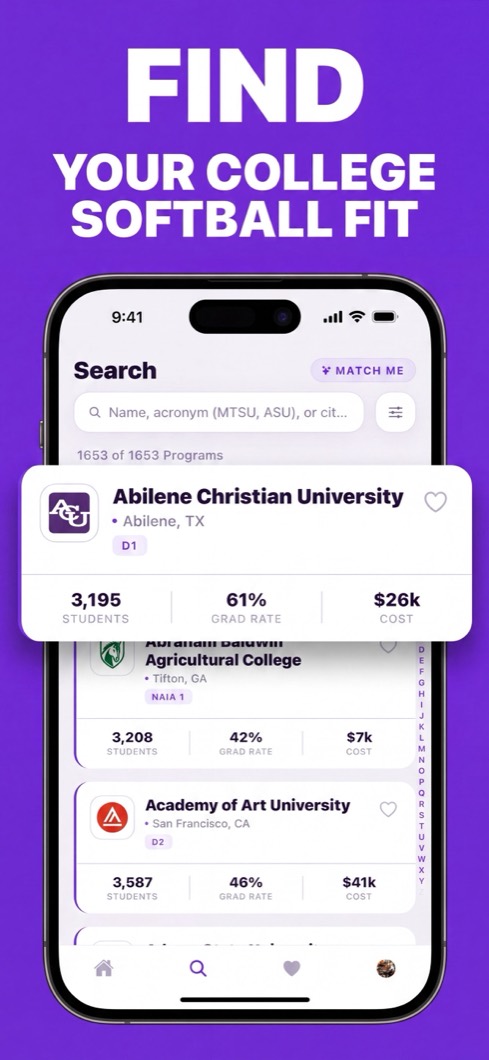
Search every NCAA, NAIA, and JUCO program. Filter by state, conference, or division, or use the Me Filter to match schools to your GPA and test scores.
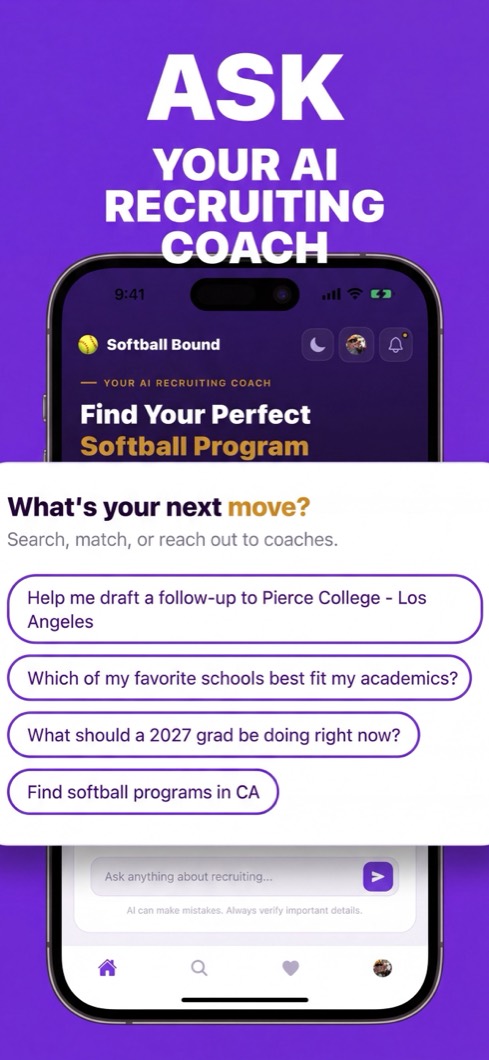
Every program page has current coach emails and phone numbers. Ask the AI recruiting coach about any school, then let it draft a personalized email you can send in one tap.
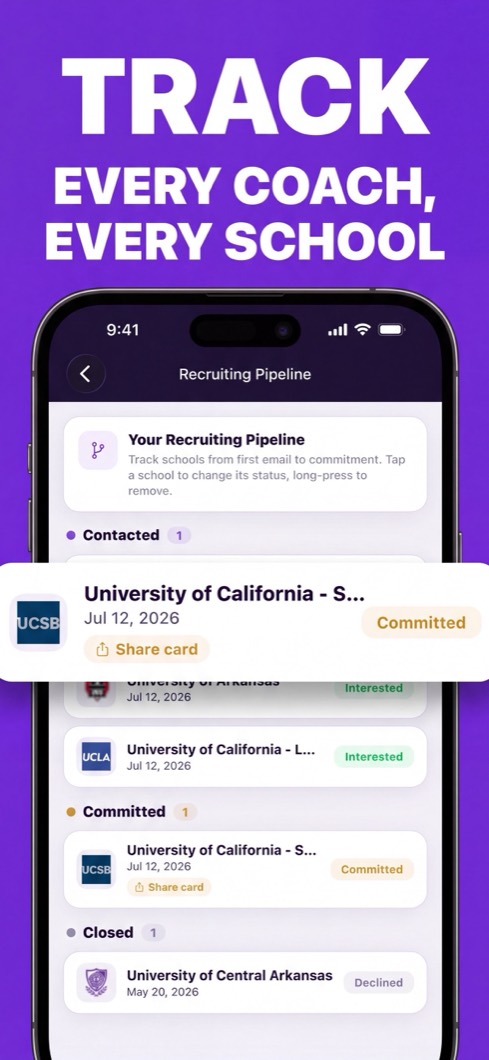
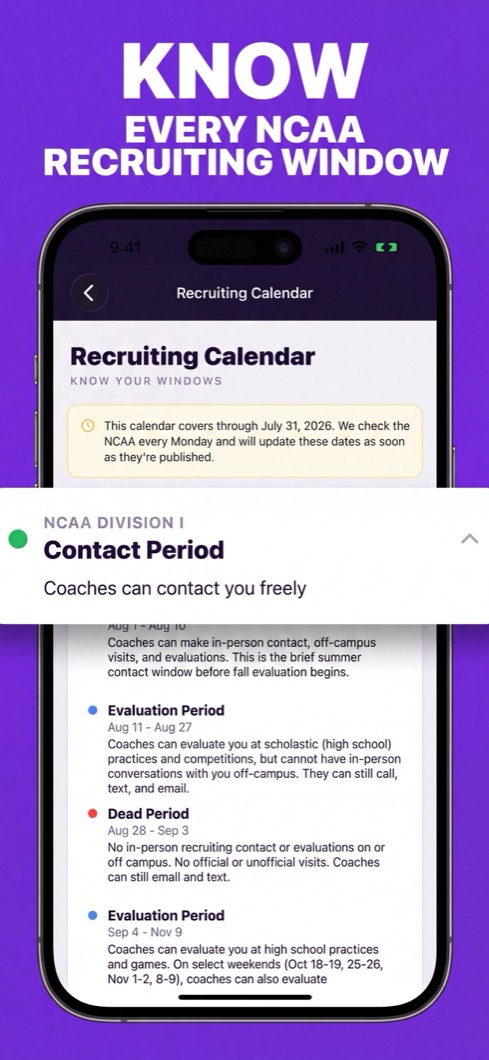
Save favorites, get notified when coaches change, follow NCAA and NAIA calendar deadlines, and move each school through your recruiting pipeline until you announce your commitment.
Real App Store reviews from athletes, parents, and coaches.
My daughter is a 2024, and committed to an SEC school to play softball in September. The recruiting journey was not too stressful, and one of the main reasons was this app !! This app is so helpful, especially if you are on the go as most softball parents are. With the help of this app, my family and I were able to make a email list of target schools. Thank you for the time put in!!
Excellent info at a tough of a button. Very helpful at Showcase events to access teams conference and cost of education at the school. This app never crashes and coaches info and links are always current. I'm a travel coach and college recruiter. The highly accurate info has really helped me know the name and school info of the college coach I find myself talking to. My preferred Softball App.
This app has been amazing!! You get everything right here.... from a coach's email or phone number, to the average ACT score of their students. It helps choose the right place because it gives so much information including the average salary of their graduating seniors. It's definitely worth every single penny!
Easy to use app with lots of useful information for anyone looking at playing in college and researching schools of interest. Highly recommend it and have used it for information for both my daughters going on to play at a collegiate level!
Every NCAA, NAIA, and JUCO softball program, with school, academic, and cost data on each one.
Emails and phone numbers for coaching staffs, updated when programs make changes.
School size, tuition, financial aid, GPA and SAT/ACT ranges, and graduation rates side by side.
Enter your GPA and test scores and see which schools are a realistic academic match.
Ask about any school and get a straight answer, then have it draft your email to the coach.
Track each school from first contact to commitment, so nothing falls through the cracks.
NCAA and NAIA contact periods, dead periods, and deadlines, with alerts before they hit.
Save schools and get notified when a coach leaves, arrives, or the program changes.
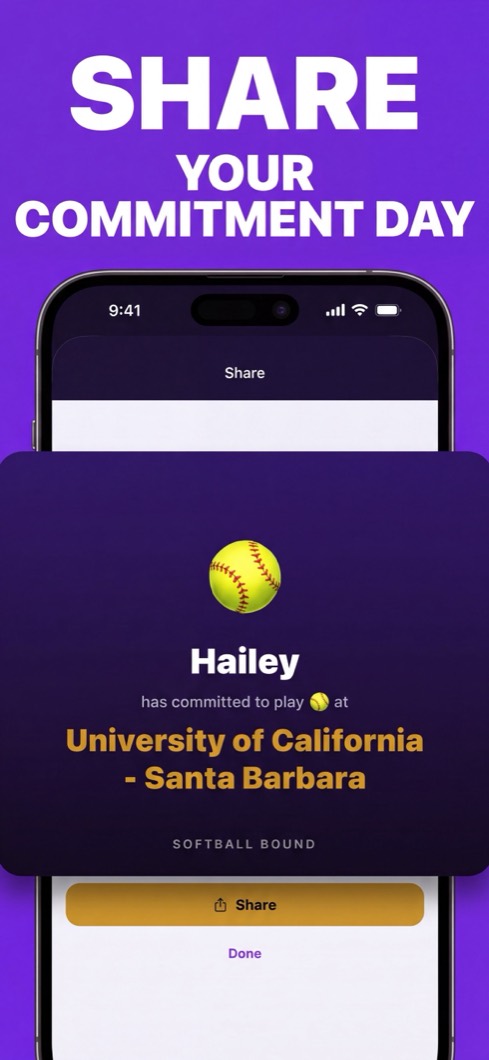
Build your profile, and when you commit, share the announcement from the app. Plus Teams for coaches, home screen widgets, and an Apple Watch app on iOS.
Straight answers to the questions softball families actually search for.
Understand college softball recruiting from first email to signing: how coaches find players, when NCAA rules...
Get recruited for college softball without an agency: build a 20 to 40 school list, make...
A year-by-year softball recruiting timeline from freshman to senior year, with the NCAA contact dates that...
What to put in a recruiting email to a college softball coach, in what order, and...
Know when college softball coaches can call, watch, and meet you: the NCAA period types, the...
See how softball scholarships work at each level, from D1 roster limits to D2 at 7.2...
Compare D1, D2, and D3 softball on time commitment, scholarships, level of play, and campus life,...
Learn what JUCO softball is, how NJCAA divisions and scholarships work, who the junior college route...
What a softball recruiting questionnaire actually does, how coaches use them, how to fill one out...
The traits college softball coaches actually evaluate: position measurables, competition level, grades, coachability, and the signals...
An honest look at softball showcases and camps: what they cost, when they help recruiting, when...
Reach the right college softball coach the first time: why one-time coach email list spreadsheets go...
Free softball player profile, player info sheet, team roster PDF, and Excel templates built around what...
For coaches & club managers
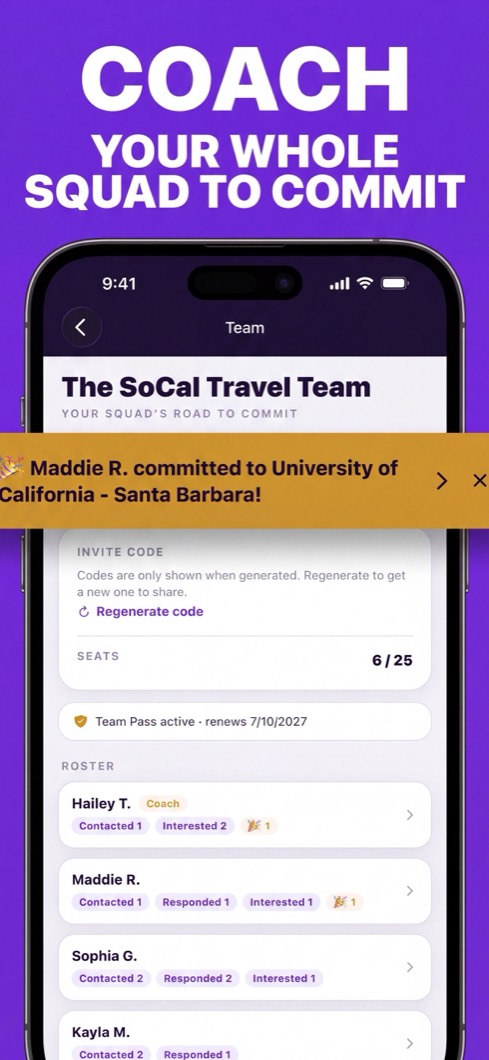
Give every player on your roster full Pro access: the AI recruiting coach, drafted coach emails, complete player profiles, and a recruiting pipeline you can follow for the whole team.
Sign up online, create your team, and invite your roster in minutes.
College coaches build their rosters two to three years ahead. They find players through travel ball, camps, video, and direct email, then evaluate grades and athletic fit before making offers. Most recruiting conversations for NCAA Division I softball cannot start until September 1 of your junior year, so the years before that are for building your grades, your video, and your target school list.
Build a target list of 20 to 40 realistic schools, put together a skills video, email each coach directly with your grad year, position, GPA, and schedule, and follow up when you have new video or results. Coaches rarely discover players on their own. Recruits who run their own process get seen.
NCAA Division I softball coaches cannot call, text, email, or DM a recruit until September 1 of the player's junior year. Division II coaches can call and email at any time and meet you in person off campus starting June 15 before junior year. Division III, NAIA, and JUCO coaches have essentially no calendar restrictions and can respond at any time.
Keep it under 200 words. Put your grad year, position, and location in the subject line. In the body: why that program specifically, your GPA and test scores, two or three verified stats, a link to your video, and your upcoming schedule. Send it yourself, from your own address, and follow up every four to six weeks with something new.
The NCAA publishes a Division I softball recruiting calendar each year that sets contact, evaluation, quiet, and dead periods. During dead periods coaches cannot watch you play or meet you in person, though they can still call and email if you are past September 1 of junior year. Three recruiting shutdowns, November 25 to 29, December 22 to 26, and December 31 to January 2, stop all recruiting including calls and email. The NCAA published the 2026-27 dates on ncaa.org, and Softball Bound tracks them with alerts.
Softball is an equivalency sport, so coaches split their scholarship budget into partial awards across the roster. Full rides are rare. Division II teams work with 7.2 scholarship equivalencies, and NAIA and NJCAA programs work under per-sport limits. Division III offers no athletic money but often strong academic aid. Since the 2025 House settlement, Division I programs that opt in can fund scholarships up to the 25-player roster limit, though most do not fully fund.
Division I is the biggest time commitment and the deepest talent pool. Division II balances athletics and school life with partial scholarships. Division III offers no athletic scholarships but strong academics and real playing careers, and its players often receive significant merit aid. The right level is the one where you can play, afford the school, and get the degree you want.
For many players, yes. Junior college gives you two years of live at-bats, a lower cost of entry, and a second recruiting window as a transfer. NJCAA Division I programs can offer full scholarships, including room and board. The tradeoff is that you have to run a second recruiting process during your freshman and sophomore years.
Yes, but know what they do. A questionnaire puts you in the program's database and signals interest; it does not get you evaluated. Fill one out for every school on your list, then email the coach directly with your video. The questionnaire is the handshake, the email is the conversation.
Measurables appropriate to your position (pitch velocity and movement, exit velocity, pop time, home-to-first speed), the ability to compete against good travel ball competition, grades that make admission and aid easy, and signs you are coachable. Grades are the quiet separator: between two similar players, the better student almost always gets the call.
No. Showcases are one way to be seen, and a well-chosen camp at a school that already knows you can help, but plenty of players get recruited through travel ball tournaments, video, and direct emails to coaches. Money spent on events a coach never asked you to attend is usually wasted.
Paid spreadsheet sellers charge for a one-time export that goes stale as soon as a coach changes jobs. A real list needs current emails, the recruiting coordinator specifically, and phone numbers, kept up to date rather than frozen at checkout. Softball Bound keeps that data live for every NCAA, NAIA, and JUCO program instead of selling a snapshot.
Yes, Softball Bound is free to download on iPhone and Android and free to use in the browser at web.softballbound.com. The free plan lets you search every program, see coach contacts for 5 schools every 30 days, and send 5 messages to the AI recruiting coach. Pro removes those limits for $2.99 a month or $29.99 a year.
Pro is $2.99 a month or $29.99 a year for one player. Coaches and club managers can buy Team Pass for $229.99 a year, which gives up to 25 players on one roster full Pro access without any of them paying.
Every program, every coach contact, and your whole pipeline in one app.
Next step, you’re Softball Bound.